
Welcome to the 2026 Summer Learning and Literacy Road Trip!
PA’s Promise for Children is excited to welcome you to the 2026 Summer Learning and Literacy Road Trip. This will be a fun, engaging journey for young children and their caregivers to learn, explore, and grow together all summer long.
This year’s theme, From Ground to Sky, encourages children to explore the natural world all around them, from the rocks beneath their feet to the native trees reaching high into the sky across Pennsylvania. Along the way, children will be invited to look closely, ask questions, and discover how nature connects to their everyday lives.
This year’s Nature Journal is your family’s travel companion! Inside, you’ll find:
- Inclusive early learning activities designed for all young children
- Hands-on nature experiences to do in your backyard, a park, or on a walk
- Family-friendly activities that support learning through play and exploration
There are pages designed especially for your young learner, as well as Family Focus pages for you as a parent, teacher, family member, friend, or caregiver!
⇒Print the Nature Journal in English or Spanish.
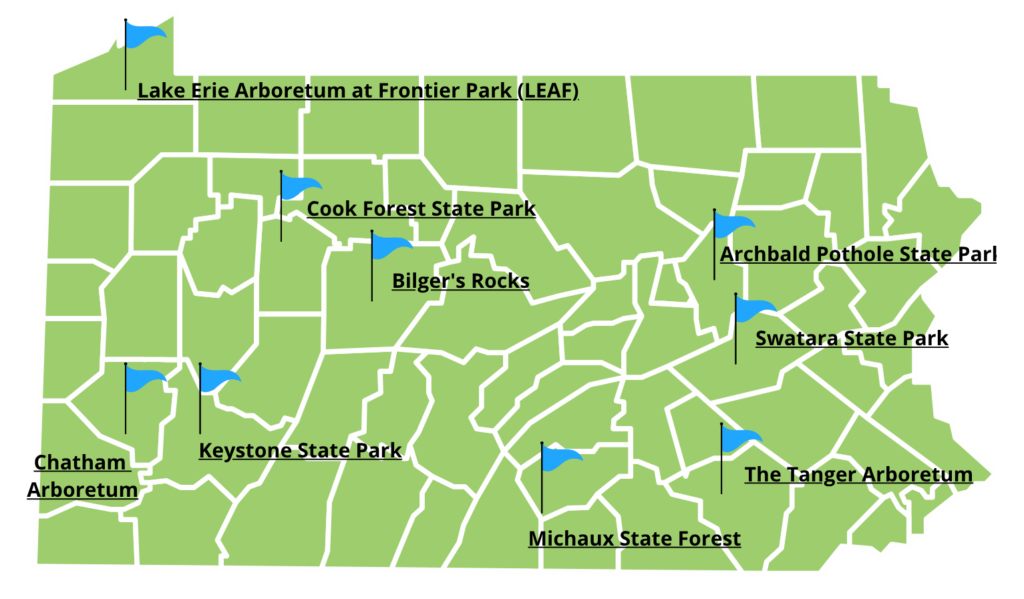
⇒You can also view and print the map, which highlights special areas in Pennsylvania to find native rocks and trees.
All activities within the Nature Journal are thoughtfully aligned with the Pennsylvania Early Learning Standards. The Early Learning Standards help children build important skills in language, literacy, curiosity, observation, and self‑regulation that will be needed as they begin school and throughout their lives.
The Summer Learning and Literacy Road Trip is about learning side by side, slowing down, and enjoying simple moments in nature. Whether you’re reading, observing, drawing, or wondering together, every activity helps build a strong foundation for lifelong learning.
As a reminder, children develop skills in many different ways. With support and flexibility, every child can explore nature and learn successfully.
If you have questions or concerns about your child’s development, please talk with your child’s healthcare professional. You can also call Pennsylvania’s CONNECT Helpline at 1-800-692-7288 for information about your child’s development and to connect with Early Intervention Services and Supports in Pennsylvania.
We’re so glad you’re joining us. Let the adventure begin, from ground to sky!
Early Learning Activities: Rocks
Build & Sort Rock Challenge
Ages: 3–7
What You Need
- A variety of rocks or stones (different sizes and shapes)
- Small containers, boxes, or trays
- Optional: paper, sticks, or blocks
How to Play
- Sort the Rocks
- Ask your child to organize rocks in their own way: By size, shape, color, or texture
- Encourage them to explain their choices: “Why did you put these together?”
- Build Something
- Use the rocks to construct something, such as: A tower, A road, A small house or structure
- They can also try stacking, lining up, grouping, or placing the items.
- Test & Change
- Encourage children to try different ideas: “What happens if we use bigger rocks on the bottom?”
- Let them rebuild and improve their design.
- Apply What They Learned
- Ask questions like: “What made your tower strong?” or “What worked better this time?”
- They can also explain ideas by talking, pointing, or demonstrating.
Make It Extra Fun
- Work together to build a rock city
- Add toy figures or cars
- Turn it into a teamwork challenge
This activity helps children organize materials, test ideas, solve problems, and apply what they learn through hands-on play, while ensuring all children can participate in their own way.
Approaches to Learning through Play Skills Your Child is Learning:
- Problem-Solving
- Planning & Organization
- Persistence & Focus
- Flexible Thinking
- Applying Knowledge
- Curiosity & Exploration
- Decision-Making
- Confidence & Independence
Kindness Rocks Activity
Ages: 3–7
What You Need
- Small rocks or stones
- Markers, paint, stickers, stamps, or crayons
- Optional: stickers
How to Play
- Create Kindness Rocks
- Help your child decorate each rock.
- Add simple kind words or symbols like:
“Kind” “Share” A heart “Thank you”
- Talk About Kindness
- Ask: “What does it mean to be kind?”
- Give examples like helping a friend or sharing toys.
- Play the Kindness Game
- Take turns picking a rock.
- Act out or describe a kind thing you can do that matches the rock.
- Spread Kindness
- Place rocks somewhere special:
- Give one to a friend or family member
- Leave one for someone to find (with help)
- Talk about how kindness makes others feel.
- Place rocks somewhere special:
Make It Extra Fun
- Create a kindness jar and add rocks over time
- Celebrate when your child shows kindness during the day
- Use rocks as reminders (“Pick a kindness rock for today!”)
This activity helps children practice kind choices, empathy, and understanding how their actions affect others. These are all key parts of social and emotional development.
Social-Emotional Skills Your Child is Learning:
- Kindness & Empathy
- Positive Social Behaviors
- Emotional Awareness
- Perspective-Taking
- Self-Confidence
- Communication Skills
- Responsibility & Decision-Making
Rock Letter Builders
Ages: 3–6
What You Need
- 10–20 small rocks or stones
- Marker, chalk, or paint
- Paper (optional)
How to Play
- Make Letter Rocks
- Write one letter on each rock (focus on a few letters at a time).
- You can use letters from your child’s name to start.
- Find & Name the Letter
- Spread the rocks out.
- Ask your child to pick one and say the letter and its sound (e.g., “B says /b/”).
- Build Simple Words
- Help your child line up rocks to form short words like: cat, sun, dog
- Say the word together, sounding it out.
- Match Sounds to Objects
- Say a sound (like “sss”).
- Ask your child to find the matching rock (“S”).
Make It Extra Fun
- Let your child decorate the rocks using stickers, paint or other craft materials.
- Hide them for a letter treasure hunt.
- Create silly rock words and laugh together!
This playful activity helps children connect letters, sounds, and simple words in a hands-on way.
Literacy Skills Your Child is Learning:
- Letter Recognition
- Phonemic Awareness (Letter Sounds)
- Alphabet Knowledge
- Early Spelling Skills
- Word Awareness
- Sound–Letter Connection (Phonics)
- Vocabulary Development
Rock Counting & Sorting Game
Ages: 3–6
What You Need
10–20 small rocks or stones
A few containers (cups, bowls, or muffin tins)
Optional: marker or chalk
How to Play
- Count the Rocks
- Place the rocks in a pile.
- Ask your child to count them out loud as they move each one.
- For younger kids, count together.
- Sort by Size or Color
- Have your child group rocks into categories:
- Big vs. small
- Light vs. dark
- Ask questions like: “Which group has more?”
- Have your child group rocks into categories:
- Number Match (Optional)
- Write numbers (1–5 or higher) on paper or containers.
- Have your child place the correct number of rocks in each one.
- Simple Addition Fun
- Say: “Put 2 rocks here and 3 rocks there.”
- Ask: “How many are there altogether?”
- Let them combine the groups to find the answer.
Make It Extra Fun
- Let your child decorate rocks with faces or colors.
- Turn it into a scavenger hunt: collect rocks outside first!
- Use a timer and make it a game (“Can you sort them in 30 seconds?”)
This activity builds early math skills while keeping things playful and hands-on.
Mathematical Thinking and Expression Skills Your Child is Learning:
- Counting & One-to-One Correspondence
- Sorting & Classifying
- Comparing Quantities
- Number Recognition
- Basic Addition & Early Operations
- Fine Motor Skills (Supports Math Learning)
- Early Problem-Solving & Critical Thinking
Sink or Float Rock Experiment
Ages: 3–6
What You Need
- A variety of rocks or stones (different sizes/shapes)
- A bowl or tub of water
- Optional: other small objects (leaf, plastic toy, stick)
How to Play
- Make Predictions
- Show your child each rock.
- Ask: “Do you think this will sink or float?”
- Let them guess before testing.
- Test the Rocks
- Gently drop each rock into the water.
- Watch what happens together.
- Observe & Compare
- Talk about results:
- “All the rocks sank!” “This one fell faster than that one!”
- Talk about results:
- Try Other Objects
- Add a leaf or toy and compare:
- Which float? Which sink?
- Add a leaf or toy and compare:
Make It Extra Fun
- Use a chart with “sink” and “float” columns to sort results.
- Let your child splash and explore safely.
- Turn it into a guessing game!
This hands-on activity introduces simple science ideas like heavy vs. light, materials, and observing results in a fun and engaging way.
Scientific Thinking and Technology Skills Your Child is Learning:
- Observation Skills
- Making Predictions
- Cause and Effect
- Comparing & Classifying
- Understanding Material Properties
- Asking Questions
- Recording & Communicating Results (Early Data Skills)
Rock Community Builder
Ages: 3–7
What You Need
- Small rocks or stones
- Marker, paint, stickers
- Paper or cardboard (optional)
How to Play
- Create Community Rocks
- Draw simple pictures on rocks to represent places or people, such as House, School, Store, Park, Helpers (doctor, firefighter, teacher)
- Build a Mini Community
- Arrange the rocks on the ground or paper to make a town.
- Place roads, buildings, and people where they belong.
- Talk About Community Roles
- Ask questions like:
- “Who works at the school?” “Where do we go to buy food?”
- Help your child connect each place and person to its role.
- Ask questions like:
- Act It Out
- Use the rocks to tell simple stories, like going to school, visiting the park, or helping a neighbor
Make It Extra Fun
- Add toy cars or figures
- Take a walk or look at photos and compare your rock town to your real community
- Let your child rearrange the town and explain their choices
This activity helps children understand how communities work, who helps in them, and how places and people are connected in everyday life.
Social Studies Skills Your Child is Learning:
- Understanding Communities
- Awareness of Community Roles
- Connection Between People and Places
- Mapping & Spatial Awareness
- Sense of Belonging
- Problem-Solving & Planning
Communication & Storytelling
Story Stones Art & Imagination Game
Ages: 3–7
What You Need
- Smooth rocks or stones
- Markers, paint, stickers, stamps, or crayons
- Optional: stickers or glue-on materials
How to Play
- Create Story Stones
- Help children decorate rocks with simple pictures, such as: A sun, A tree, A house, A person, An animal
- Pick & Imagine
- Place the rocks in a small pile or bag.
- Each child picks 2–3 rocks.
- Tell a Story
- Use the pictures to create a simple story:
- “Once there was a dog who lived by a big tree…”
- Encourage children to communicate in any way they can: Speaking, Gestures, Acting it out, Pointing to the rocks
- Use the pictures to create a simple story:
- Share & Celebrate
- Take turns sharing stories.
- Celebrate every child’s ideas and creativity.
Make It Extra Fun
- Add music or sound effects
- Build a group story together
- Use a favorite rock to inspire the story
Creative Thinking and Expression Skills Your Child is Learning:
- Imagination & Creativity
- Symbolic Thinking
- Storytelling Skills
- Expressive Communication
- Confidence in Self-Expression
- Collaboration & Sharing Ideas
- Creative Problem-Solving
- Artistic Expression
Rock Toss & Move Game
Ages: 3–7
What You Need
- 5–10 small rocks or bean bags
- A basket, bucket, or container
- Open space (indoors or outdoors)
How to Play
- Set Up the Target
- Place a basket or container a short distance away. Move the target closer or farther based on ability.
- Give your child a few rocks to hold.
- Practice Tossing
- Have your child try to toss rocks into the container.
- Encourage them to aim and throw gently. Allow rolling or placing objects instead of tossing.
- Add Movement
- After each toss, ask your child to do a fun movement, such as:
- Jump, clapping, tapping knees, or raising arms three times
- Spin around, marching in place or rolling shoulders
- Hop on one foot, turning head or moving arms side-to-side
- After each toss, ask your child to do a fun movement, such as:
- Move Closer or Farther
- Change the distance to make it easier or more challenging.
- Celebrate effort, not just success!
Make It Extra Fun
- Create a simple obstacle path to walk before tossing
- Play music while moving
- Take turns as a family
This activity helps children build coordination, balance, strength, and healthy movement habits while having fun and staying active.
Health, Wellness, and Physical Development Skills Your Child is Learning:
- Gross Motor Skills
- Hand–Eye Coordination
- Balance & Body Control
- Confidence & Self-Esteem
- Body Awareness
- Positive Attitudes Toward Physical Activity
- Cooperation & Inclusion
- Strength & Endurance
Early Learning Activities: Trees
Pick one tree to visit during the year.
Look closely and talk about what you see.
- Spring: Do you see buds, flowers, or tiny leaves?
- Summer: Are the leaves big, green, and shady?
- Fall: What colors are the leaves? Are they falling?
- Winter: Is the tree bare? Can you see the branches better?
Draw a picture or say one word to describe the tree each season.
Tree Detective Play
Ages: 3–7
What You Need
- Trees nearby (yard, park, sidewalk, or school grounds)
- Your eyes, hands, and imagination
- Optional: paper and crayons
How to Play
- Look Closely
- Choose one tree.
- Ask your child to notice: Is the tree tall or short? Is the bark smooth or rough? Are there leaves, needles, or none?
- Compare & Sort
- Visit another tree.
- Ask: “How is this tree the same?” “How is it different?”
- Let children group trees by size, leaf shape, or texture.
- Visit another tree.
- Solve a Tree Problem
- Ask playful questions: “Which tree gives the most shade?” “Which tree would be best for a bird?”
- Encourage children to explain their thinking.
- Apply What They Learned
- Have your child point to a tree and say: “I know this tree because…”
- They can draw it, describe it, or act like it in the wind.
This activity helps children practice curiosity, focus, flexibility, and thinking skills as they explore, compare, and explain what they notice, key parts of learning how to learn through play.
Approaches to Learning through Play Skills Your Child is Learning:
- Curiosity & Initiative
- Observation Skills
- Problem‑Solving
- Persistence & Focus
- Flexible Thinking
- Applying Knowledge
- Confidence & Independence
Tree Feelings Circle
Ages: 3–7
What You Need
- A tree nearby (yard, park, or sidewalk)
- A quiet moment together
- Optional: a small rock or leaf
How to Play
- Sit by a Tree
- Invite your child to sit or stand near a tree.
- Take a deep breath together and notice the tree.
- Name Feelings
- Ask gentle questions: “How do you feel right now?” “If this tree had feelings, what would it feel?”
- Offer choices if helpful (happy, calm, tired, excited).
- Tree Breathing
- Pretend to be a tree: Feet are roots, Arms are branches
- Breathe in slowly (branches up), breathe out slowly (branches down).
- Share & Connect
- Take turns sharing one thing that made you feel good today
- You can pass a leaf or rock when it’s someone’s turn.
This activity helps children identify emotions, calm their bodies, feel heard, and connect with others, using nature as a peaceful and supportive setting.
Social-Emotional Skills Your Child is Learning:
- Emotional Awareness
- Self‑Regulation & Calming Skills
- Empathy
- Mindfulness & Focus
- Communication of Feelings
- Confidence & Sense of Safety
- Social Connection & Turn‑Taking
Tree Word Walk
Ages: 3–7
What You Need
- Trees nearby (yard, park, neighborhood, or playground)
- Your voices and curiosity
- Optional: paper and crayons
How to Play
- Name What You See
- Stand near a tree and point to different parts: Trunk, Leaves, Branches, Roots (talk about where they are)
- Say the words together.
- Describe the Tree
- Ask your child questions like: “Is the bark rough or smooth?” “Are the leaves big or small?”
- Encourage full sentences if possible, but single words are great too.
- Tree Sounds & Rhymes
- Make up a silly rhyme or sound about the tree: “Tall tree, small tree, wiggly‑wiggly tree!”
- Clap or tap to the rhythm of the words.
- Tell a Tree Story
- Invite your child to imagine: “Who might live in this tree?”
- Help them tell a short story using their ideas.
This activity builds language skills through conversation, description, and storytelling, helping children learn new words and express ideas while exploring nature.
Language and Literacy Skills Your Child is Learning:
- Vocabulary Development
- Expressive Language
- Listening & Comprehension
- Descriptive Language
- Phonological Awareness
- Storytelling & Narrative Skills
- Confidence in Communication
Tree Math Walk
Ages: 3–7
What You Need
- Trees nearby (yard, park, neighborhood)
- Your eyes and fingers
- Optional: paper and crayons
How to Play
- Count the Trees
- Walk together and count how many trees you see.
- Count out loud, touching or pointing to each tree.
- Compare Trees
- Ask questions like: “Which tree is taller?” “Which tree has more branches?”
- Use words such as more, less, same, tall, short.
- Measure with Your Body
- Have children: Wrap arms around a trunk or take steps from one tree to another
- Ask: “How many steps did it take?”
- Sort & Group
- Group trees by what you notice: Big vs. small, Leaves vs. needles
This activity helps children use math to count, compare, measure, and explain ideas, building early number sense through real‑world exploration.
Mathematical Thinking & Expression Skills Your Child is Learning:
- Counting & Number Sense
- Comparing Quantities & Size
- Measuring & Estimating
- Sorting & Classifying
- Using Math Language
- Problem‑Solving
- Connecting Math to the Real World
Tree Science Explorer
Ages: 3–7
What You Need
- A tree nearby (yard, park, or neighborhood)
- A simple “tool” (magnifying glass, phone camera, or binoculars)
- Optional: paper and crayons
How to Play
- Observe Like a Scientist
- Look closely at the tree using your eyes or a tool.
- Notice: Bark patterns, Leaves or needles, Bugs, birds, or holes
- Ask Questions
- Encourage curiosity with questions like: “What do you think lives in this tree?” “Why do you think the bark looks like that?”
- Make a Prediction
- Ask: “What do you think will change if we come back in a different season?”
- Talk about possible answers together.
- Use Technology
- Take a photo or short video of the tree.
- Compare it later to see changes over time (new leaves, color changes).
This activity introduces children to scientific thinking, like observing, asking questions, predicting, and using tools, while helping them understand that technology can help them learn about the world around them.
Scientific Thinking & Technology Skills Your Child is Learning:
- Observation Skills
- Curiosity & Questioning
- Predicting & Reasoning
- Understanding Cause & Effect
- Using Tools & Technology
- Comparing Over Time
- Communication of Ideas
- Confidence as a Learner
Trees in Our Community
Ages: 3–7
What You Need
- Trees nearby (yard, park, school, or neighborhood)
- A short walk and conversation
How to Play
- Look Around Your Community
- Walk together and notice trees in your area.
- Ask: “Where do we see trees?” “Why do you think trees are here?”
- Talk About What Trees Do for People
- Share simple ideas: Trees give shade. Trees help animals, Trees make places beautiful
- Connect to Community Helpers
- Ask: “Who helps take care of trees?”
- Talk about gardeners, park workers, or community volunteers.
- Practice Caring for Shared Spaces
- Invite your child to think of ways to help: Picking up litter near trees, Watering a tree at home, Being gentle with branches and leaves
This activity helps children understand that trees are part of their community, that people work together to care for shared spaces, and that they can play a role in helping their community.
Social Studies Skills Your Child is Learning:
- Community Awareness
- Understanding Roles & Responsibilities
- Civic Responsibility
- Environmental Awareness
- Sense of Belonging
- Communication & Listening
- Decision‑Making
Tree Art Imagination Play
Ages: 3–7
What You Need
- A tree to observe (yard, park, or neighborhood)
- Paper and crayons, markers, or chalk
- Optional: leaves, sticks, or bark rubbings (no picking from living trees)
How to Play
- Look & Imagine
- Stand near a tree and ask: “What does this tree remind you of?” “If this tree could tell a story, what would it say?”
- Create Tree Art
- Invite your child to draw the tree—or turn it into something imaginary: A tree house, A friendly face, A home for animals
- Express Through Movement
- Pretend to be the tree: Stretch like tall branches or Sway like leaves in the wind
- Children can express ideas by drawing, moving, pointing, or storytelling
- Share the Creation
- Let your child talk about, point to, or act out their artwork or idea.
- Celebrate every idea—there is no “right” way to create.
This activity encourages children to use imagination, express ideas creatively, and communicate through art and movement, helping them build confidence and joy in creative expression.
Creative Thinking and Expression Skills Your Child is Learning:
- Imagination & Creativity
- Artistic Expression
- Symbolic Thinking
- Self‑Expression
- Creative Movement
- Communication Skills
- Confidence & Joy in Creating
Tree Stretch & Move Break
Ages: 3–7
What You Need
- A tree nearby (yard, park, or neighborhood)
- Comfortable space to move
- Your imagination!
How to Play
- Stand Like a Tree
- Have children stand tall like a tree trunk.
- Feet are roots planted on the ground.
- Stretch the Branches
- Reach arms up high like branches growing.
- Stretch side to side like branches in the wind.
- Balance Like a Tree
- Try standing on one foot like a tree with one strong root.
- Switch feet if able.
- Shake & Relax
- Gently shake arms and legs like leaves rustling.
- Take a slow breath in and out together.
Movements can be done:
- Standing, sitting, or supported
- Big or small—any effort counts
- Children may watch, copy, or participate in their own way
This activity encourages healthy movement, balance, stretching, and calm breathing, helping children build physical strength, body awareness, and positive feelings about being active.
Health, Wellness, and Physical Development Skills Your Child is Learning:
- Gross Motor Skills
- Balance & Coordination
- Body Awareness
- Flexibility & Strength
- Self‑Regulation & Calming
- Positive Attitudes Toward Physical Activity
- Confidence & Participation
Explore more!
Check out these resources to explore more of rocks in Pennsylvania!
- Rocks of Pennsylvania Early Learning Guide (PA’s Promise for Children)
- 8 Books about Rocks (PA’s Promise for Children)
- Pennsylvania State Parks
- Trail of Geology Series (PA Department of Conservation and Natural Resources)
- State Museum of Pennsylvania (Harrisburg, PA)
- Montour Preserve Fossil Pit (Danville, PA)
- PA State Parks, Forests and Geology Interactive Map (PA Department of Conservation and Natural Resources)
- Geology Education – Resources for Teachers (PA Department of Conservation and Natural Resources)
- Order a Rock Box (PA Department of Conservation and Natural Resources)
- County Rock-Type Maps of Pennsylvania (PA Department of Conservation and Natural Resources)
- Stonework Play, A Gift of Kindness (Community Playthings)
- DCNR GeoTrail
Check out these resources to explore more of the trees in Pennsylvania!
- Trees of Pennsylvania Early Learning Guide (PA’s Promise for Children)
- 12 Books about Trees (PA’s Promise for Children)
- Pennsylvania State Parks
- Awbury Arboretum (Philadelphia, PA)
- Chatham Arboretum (Pittsburgh, PA)
- Jenkins Arboretum & Gardens (Devon, PA)
- Lake Erie Arboretum at Frontier Park (Erie, PA)
- The Arboretum at Penn State (State College, PA)
- The Arboretum (Reading, PA)
- The Tanger Arboretum (Lancaster, PA)
- Ambler Arboretum (Ambler, PA)
- Learning is in Our Nature (Project Learning Tree)
- PA State Parks, Forests and Geology Interactive Map (PA Department of Conservation and Natural Resources)
- Maps of Native Trees and Plants in Pennsylvania (PlantMaps)
- PA Plants Native
- Tree Pennsylvania
- DCNR GeoTrail
